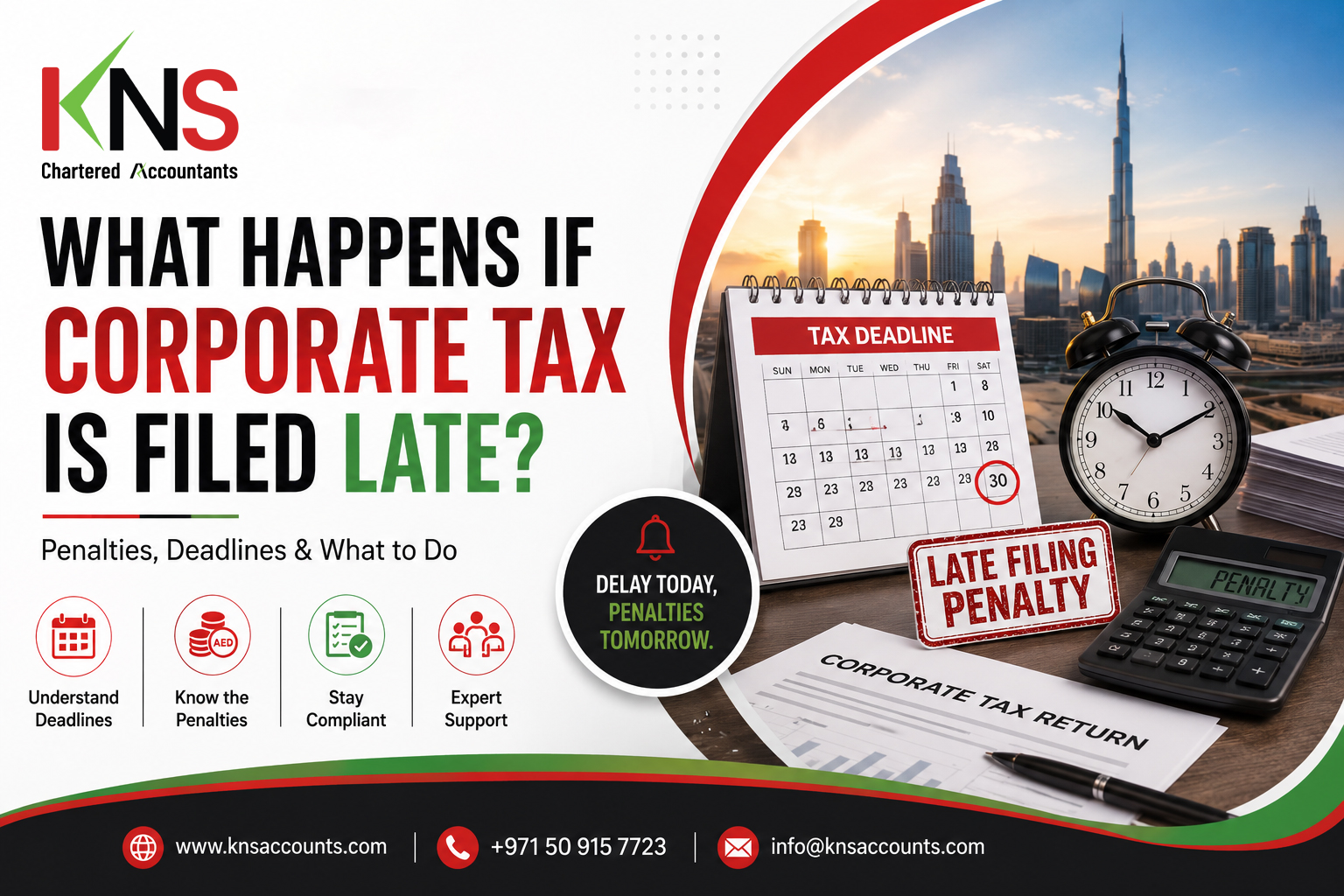
Missing your UAE Corporate Tax return filing deadline can result in penalties, compliance issues, and additional administrative costs for your business.
Under the UAE Corporate Tax regime, businesses that are required to register and file a Corporate Tax return must submit the return and pay any Corporate Tax due within the applicable deadline prescribed by the Federal Tax Authority (FTA).
If your business has missed its deadline, it is important not to ignore the situation. Filing as soon as possible can help you regularise your tax position and avoid further compliance complications.
This guide explains what happens when a UAE Corporate Tax return is filed late, the applicable penalties, how the filing deadline works, and what businesses should do after missing a deadline.
Quick Answer: What Happens If You File Corporate Tax Late?
If a UAE business files its Corporate Tax return after the prescribed deadline, the FTA may impose an administrative penalty for late filing. The business may also face additional consequences if Corporate Tax remains unpaid.
The best course of action is to:
- Check your Corporate Tax registration and filing deadline.
- Determine whether the return is overdue.
- Prepare the required financial and tax information.
- File the Corporate Tax return as soon as possible.
- Pay any Corporate Tax and applicable penalties due.
- Review your future compliance deadlines to prevent another late filing.
Late filing does not mean the business should delay further. Taking corrective action quickly can help bring the business back into compliance.
What Is the Corporate Tax Filing Deadline in the UAE?
The UAE Corporate Tax return generally needs to be submitted within nine months from the end of the relevant Tax Period, unless the FTA specifies otherwise.
For example, if a company’s Tax Period ends on 31 December 2025, its Corporate Tax return and payment would generally be due by 30 September 2026.
However, the actual deadline can vary depending on the company’s Tax Period and applicable Corporate Tax rules.
Example
Suppose:
- Financial year: 1 January 2025 – 31 December 2025
- Tax Period ends: 31 December 2025
- Corporate Tax return deadline: 30 September 2026
If the company submits its return after the applicable deadline, it may be subject to the relevant FTA late-filing penalty.
Businesses should therefore determine their specific Tax Period and filing deadline rather than assuming that every UAE company has the same deadline.What Is the Penalty for Late Corporate Tax Filing in the UAE?
The UAE’s Corporate Tax penalty framework includes an AED 500 administrative penalty for each month, or part of a month, that the Corporate Tax return is late, for the first twelve months. From the thirteenth month onwards, the penalty increases to AED 1,000 per month, or part thereof.
This means even a relatively short delay can create a penalty.
Example of how the penalty can accumulate
If a company files its Corporate Tax return:
| Delay | Potential late-filing penalty |
|---|---|
| 1 month | AED 500 |
| 2 months | AED 1,000 |
| 3 months | AED 1,500 |
| 6 months | AED 3,000 |
| 12 months | AED 6,000 |
| More than 12 months | Higher penalty may apply |
Important: The calculation of penalties can depend on the applicable UAE tax legislation and the specific circumstances of the taxpayer. Businesses should verify their position through the FTA’s current rules and their EmaraTax account.
Does Late Corporate Tax Filing Affect Your Business?
Yes. The consequences can go beyond the immediate penalty.
1. Financial penalties
The most obvious consequence is the administrative penalty for failing to submit the Corporate Tax return within the prescribed deadline.
For businesses that repeatedly miss deadlines, these penalties can become a significant compliance cost.2. Additional payment obligations
Late filing and late payment are separate compliance issues.
If your company has Corporate Tax payable and does not pay it within the prescribed deadline, late-payment penalties may also apply.
Therefore, a business should not only ask:
“Did we file the return?”
It should also ask:
“Did we pay the Corporate Tax due on time?”
3. Increased compliance risk
Repeatedly missing tax deadlines can increase the company’s overall compliance risk.
Businesses should maintain accurate:
- Accounting records
- Tax records
- Invoices
- Financial statements
- Corporate Tax calculations
- Tax registration information
- Supporting documentation
Proper bookkeeping and timely tax preparation can significantly reduce the risk of missing important deadlines.
Is There a Grace Period for Late Corporate Tax Filing?
Businesses should not assume that there is a general grace period for filing Corporate Tax returns.
The safest approach is to treat the deadline shown under the company’s Corporate Tax obligations as the actual deadline.
If the deadline has already passed, the business should proceed with filing rather than waiting for a potential grace period.
What Should You Do If You Missed Your Corporate Tax Deadline?
If your UAE business has missed its Corporate Tax filing deadline, follow these steps.
Step 1: Check Your Corporate Tax Registration
Log into your EmaraTax account and confirm:
- Corporate Tax registration status
- Tax Period
- Filing deadline
- Outstanding returns
- Penalties
- Tax payments
Step 2: Identify the Reason for the Delay
Determine why the return was not filed on time.
Common reasons include:
- Incomplete accounting records
- Lack of awareness about the Corporate Tax deadline
- Delay in financial statements
- Change in accountant
- Incorrect Tax Period information
- Internal approval delays
- Business owner assuming the company was exempt
- First-time Corporate Tax filing
Identifying the reason can help prevent the same problem from happening again.
Step 3: Complete Your Accounting Records
Before filing the return, ensure your financial information is complete and accurate.
This may include:
- Revenue records
- Expense records
- Bank statements
- Fixed asset records
- Accounts receivable
- Accounts payable
- Related-party transactions
- Supporting invoices
- Financial statements
Step 4: Calculate Your Taxable Income
Corporate Tax is not necessarily calculated simply by applying the tax rate to total business revenue.
The business must determine its Taxable Income according to UAE Corporate Tax rules and applicable adjustments, exemptions and reliefs.
For eligible businesses, the UAE Corporate Tax regime currently provides a 0% rate on taxable income up to AED 375,000 and 9% on taxable income exceeding AED 375,000, subject to the applicable rules.
Step 5: File the Return
Once the necessary information has been reviewed, submit the Corporate Tax return through the applicable FTA/EmaraTax process.
If the return is already overdue, filing sooner is generally preferable to allowing the delay to continue.
Step 6: Pay the Amount Due
If Corporate Tax is payable, ensure the amount is paid according to the applicable requirements.
If penalties have been imposed, review the outstanding amount shown by the FTA.
Can a Late Corporate Tax Penalty Be Waived?
In certain circumstances, taxpayers may be able to request penalty reconsideration or relief, depending on the applicable UAE tax procedures and the taxpayer’s circumstances.
However, businesses should not assume that a penalty will automatically be cancelled.
If you believe there was a valid reason for the delay or that a penalty was incorrectly imposed, you should review the applicable FTA procedures and submit the appropriate request with supporting evidence where applicable.
What If You Filed the Corporate Tax Return but Did Not Pay?
This is an important distinction.
Late filing and late payment are not the same thing.
A company may:
- File its Corporate Tax return on time but pay late.
- File its return late and pay late.
- File late but have no Corporate Tax payable.
- File on time and pay on time.
Each situation can have different consequences.
Businesses should therefore assess both filing compliance and payment compliance.
Do Small Businesses Need to Worry About Corporate Tax Filing?
Yes.
Being a small business does not automatically mean that Corporate Tax compliance can be ignored.
However, eligible resident persons may potentially benefit from Small Business Relief, subject to the applicable conditions, revenue thresholds and Tax Period requirements.
Importantly, relief from Corporate Tax does not necessarily mean that the business can ignore its Corporate Tax registration and filing obligations.
Business owners should determine their eligibility rather than assuming that no tax is payable means no return is required.
Common Reasons UAE Businesses Miss Corporate Tax Deadlines
Late filing often happens because businesses underestimate the compliance requirements.
Some common reasons include:
1. Assuming VAT registration means Corporate Tax is automatic
VAT and Corporate Tax are separate tax regimes with different requirements.
2. Waiting until the last minute
Corporate Tax filing requires financial information, accounting records and tax calculations. Preparing everything shortly before the deadline can create unnecessary pressure.
3. Poor bookkeeping
Incomplete accounting records can delay the preparation of the Corporate Tax return.
4. Not knowing the company’s Tax Period
Businesses should know exactly when their Tax Period ends and when the corresponding return is due.
5. Assuming no tax means no filing
A business may have no Corporate Tax payable but can still have Corporate Tax compliance obligations.
How Can Businesses Avoid Corporate Tax Late Filing Penalties?
A simple compliance system can prevent most deadline-related problems.
Maintain monthly bookkeeping
Do not wait until the Corporate Tax deadline to organise your accounts.
Reconcile bank accounts regularly
Regular bank reconciliation makes year-end tax preparation much easier.
Track your Tax Period
Maintain a tax compliance calendar containing:
- Corporate Tax registration deadline
- Corporate Tax return deadline
- Payment deadline
- VAT return deadlines, where applicable
- Other regulatory deadlines
Start preparing early
Ideally, businesses should begin preparing their Corporate Tax return well before the deadline.
Work with a qualified tax professional
A UAE tax consultant or accounting firm can help businesses manage:
- Corporate Tax registration
- Tax return preparation
- Tax calculations
- Bookkeeping
- Compliance reviews
- FTA correspondence
- Penalty-related matters
Corporate Tax Late Filing vs VAT Late Filing
Businesses often confuse the two.
| Corporate Tax | VAT |
|---|---|
| Applies under the UAE Corporate Tax regime | Applies under the UAE VAT regime |
| Filing deadline depends on the relevant Tax Period | Filing frequency depends on the VAT tax period |
| Corporate Tax return generally due within 9 months from Tax Period end | VAT returns generally follow the assigned VAT tax period |
| Separate registration and compliance obligations | Separate VAT registration and compliance obligations |
| Late filing penalties may apply | VAT late filing/payment penalties may apply |
Having a VAT compliance system does not automatically guarantee Corporate Tax compliance.
Frequently Asked Questions About Late Corporate Tax Filing in the UAE
What happens if I file Corporate Tax late in the UAE?
The FTA may impose an administrative penalty for late submission. Additional penalties may apply if Corporate Tax or other amounts remain unpaid.
How much is the UAE Corporate Tax late filing penalty?
The administrative penalty for late filing is AED 500 per month or part of a month for the first 12 months, increasing to AED 1,000 per month or part thereof from the 13th month onwards, subject to the applicable regulations.
Is there a grace period for Corporate Tax filing?
Businesses should not assume that a general grace period applies. The applicable filing deadline should be followed, and overdue returns should be filed as soon as possible.
Can I file my Corporate Tax return after the deadline?
Yes, an overdue return can still be filed. If you have missed the deadline, you should generally take corrective action promptly rather than continuing to delay the filing.
What happens if Corporate Tax is filed late but no tax is payable?
A late filing penalty may still apply because filing compliance and the amount of Corporate Tax payable are separate matters.
Can the FTA waive a Corporate Tax penalty?
Depending on the circumstances and applicable procedures, a taxpayer may be able to request reconsideration or penalty relief. Approval is not automatic.
Does late filing affect my company’s tax compliance status?
Late filing can create outstanding compliance obligations and penalties. Businesses should regularise overdue returns and settle applicable amounts.
Do companies with no profit need to file Corporate Tax?
Businesses should not assume that having no profit automatically removes the filing obligation. Corporate Tax registration and filing requirements depend on the entity’s status and applicable UAE Corporate Tax rules.
Does Small Business Relief mean I don’t need to file?
Not necessarily. Eligibility for Small Business Relief and Corporate Tax filing obligations are separate considerations. Businesses should verify the applicable requirements for their Tax Period.
Can an accountant file a late Corporate Tax return?
Yes, businesses can work with qualified tax professionals or authorised representatives to assist with Corporate Tax compliance and filing.
Final Takeaway
Missing a UAE Corporate Tax deadline should not be ignored.
A late return can result in administrative penalties, while unpaid Corporate Tax can create additional financial consequences. The longer a business waits, the more difficult it can become to resolve outstanding compliance requirements.
The best approach is to:
Check → Prepare → File → Pay → Stay Compliant.
For UAE businesses, maintaining accurate accounting records and monitoring Corporate Tax deadlines throughout the year is much more effective than trying to resolve everything after the deadline has passed.
If your business has already missed its Corporate Tax filing deadline, getting professional assistance can help you understand the outstanding obligations, prepare the required return and address applicable penalties.
Need Help With UAE Corporate Tax Compliance?
KNS Accounts helps UAE businesses with Corporate Tax registration, accounting, tax return preparation and ongoing tax compliance.
Don’t wait for penalties to increase. Review your Corporate Tax compliance before your next deadline.
Book a Corporate Tax consultation with KNS Accounts today.